Constraints
Any candidate for a "Programmer God (1)" simulation universe source code, including this model, must satisfy these conditions;
1. It can generate physical structures (mass, space, time ...) from mathematical forms.
2. The universe in totality is dimensionless (existing as data on a celestial hard disk).
3. It must be able to explain observations of nature (aka physics, chemistry ...).
4. The mathematical logic must be unknown to us (the Programmer is a non-human intelligence).
5. The coding should have an 'elegance' commensurate with the Programmer's level of skill.
Summary
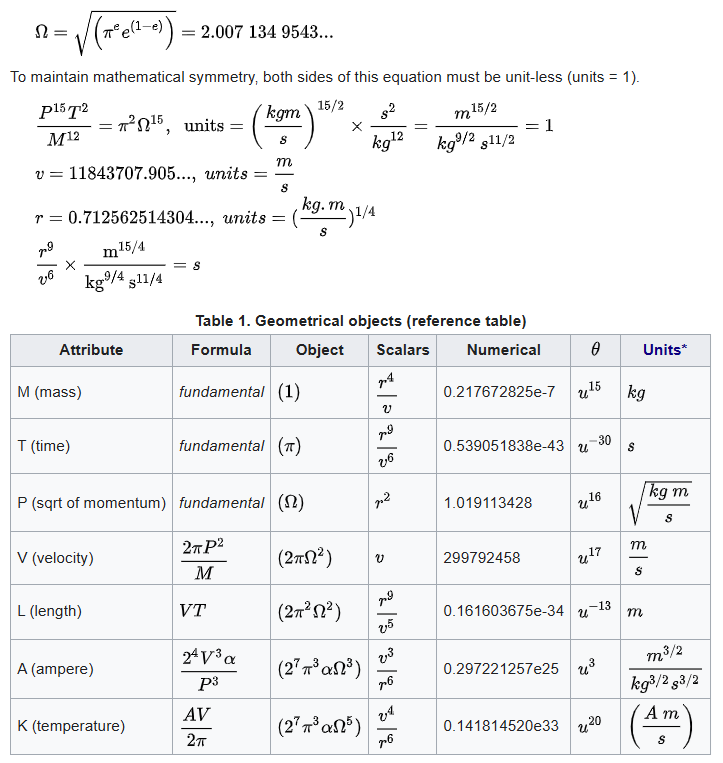
1. At the sub Planck level (a mathematical state) runs a continuous loop generating rotation (pi) and expansion (e) until it reaches the boundary conditions defined by the formula \(\Omega = \sqrt{ \left(\pi^e e^{(1-e)}\right)}\) and by \(\pi^2\). These components are mathematically symmetrical with geometrical Planck units M=1, T=\(\pi\) and P=\(\Omega\) which are then deposited. The internal loop resets and restarts, the physical universe built in these incremental MTP Planck unit steps - Article 1b.
2. The electron formula \(\psi = 4\pi^2(2^6 3 \pi^2 a \Omega^5)^3\), although a dimensionless mathematical formula, embeds all the information required to generate the physical electron parameters.
The table (left) lists the derivations of the Planck units from \(\pi\) and \(\Omega\). The calculator (right) uses this table to calculate the physical constants from \(c, \mu_0\) and alpha as the input ('0' is default) - Article 6.
I used Gemini AI to make podcasts to introduce each sections, for the full list see podcasts. This podcast gives an overview of the model.
I also used wiki sites originally as their link structure could be used to reduce the text length (most physical terms have well maintained pages of their own). The pages are still up although not regularily maintained.
(1) wiki God_(programmer), theprogrammergod.com/
(2) wiki Planck_units_(geometrical)
(3) wiki Electron_(mathematical)
(4) wiki Gravity_via_Atomic_orbitals
Core articles
Article 6. introduces the method by which physical units are generated from mathematical forms. Article 1b. shows how this process occurs at the sub-Planck scale. Article 7. gives a full overview of the electron formula, upon which this model is built.
Three oscillation levels
Level 2: Planck units and the CMB
\(\psi_U\)
Compares the parameters for a hypothetical Planck unit universe (sans particles) with the Cosmic Microwave Background. The model postulates a Planck unit scaffolding upon which the particle universe resides and supposes that within the CMB parameters can be found evidence of this non-baryonic background.
Read ArticleLevel 0: Sub Planck scale, the tau function
\(\psi_{\tau}\)
By treating the universe as a continuous internal evaluation function (the \(\tau\)-loop) driven by pi and Euler's identity, we show how the Planck units organically emerge from mathematical forms.
Read ArticleLevel 3: The container universe (philosophy)
\(\psi_H\)
If the universe \(\psi_U\) oscillates, does it too exist as a particle within some greater realm \(\psi_H\), and eventually will it also collapse into a point-state? And if so, what would the physics inside \(\psi_H\) look like? A look at some long standing philosophical questions from the perspective of this model.
Read Article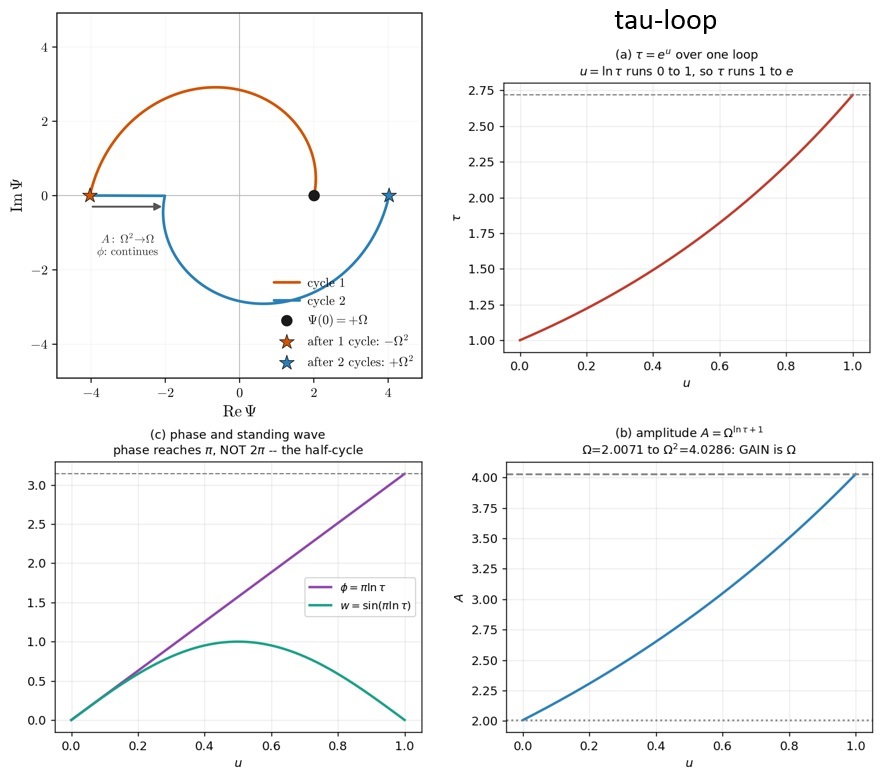
Research Path (Article series transcribed to HTML)
Each article was developed independently over the years (the project began in 2003) and so naming of variables is not consistent, there are some contradictions ... I am now using AI to standardize the articles, in the meantime ...
3. Gravitational Orbitals
Replaces 'gravity' with a complex of n-body rotating particle-to-particle orbital pairs at the Planck scale. Macro observed orbits emerge over time from the sum of these underlying rotating orbitals.
Read Article4. Atomic Orbitals
By replacing wave-particle duality with a wave-state to point-state oscillation, and treating atomic orbitals as a single orbital pair, the gravitational orbital simulation program (#3) can model atomic orbital transitions within the H atom as a semi-continuous spiral and precisely reproduce the Bohr results.
Read ArticleSource codes 3. 4.
Gravitational and atomic orbits are emergent properties, the result of summed particle-particle rotating orbital pairs (forces are not used). Simulations are therefore required for comparisons with real-world orbits. The source codes used are listed here.
Read ...2. Relativity and the Hypersphere
Postulates an expanding 4-axis hypersphere in discrete Planck steps, with relativity as the mathematics of perspective, translating between 2 co-ordinate systems; 3D space and the hypersphere.
Read Article6. Natural Planck units and alpha
Gives an analytical derivation of the fine structure constant using only the CODATA values for the dimensioned physical constants. Proposes a set of natural Planck units (independent of any system of units) and a unit relationship linking the units.
Read Article7. The Mathematical Electron
Introduces a geometrical formula for the electron, develops the monopole framework and explores quark-like structures built from the Planck units.
Read Article8. Holographic Universe
Examines whether holographic descriptions emerge naturally from the Mathematical Electron framework.
Read Article5. The W-Axis
Introduces an additional geometric degree of freedom used throughout the model.
Read Article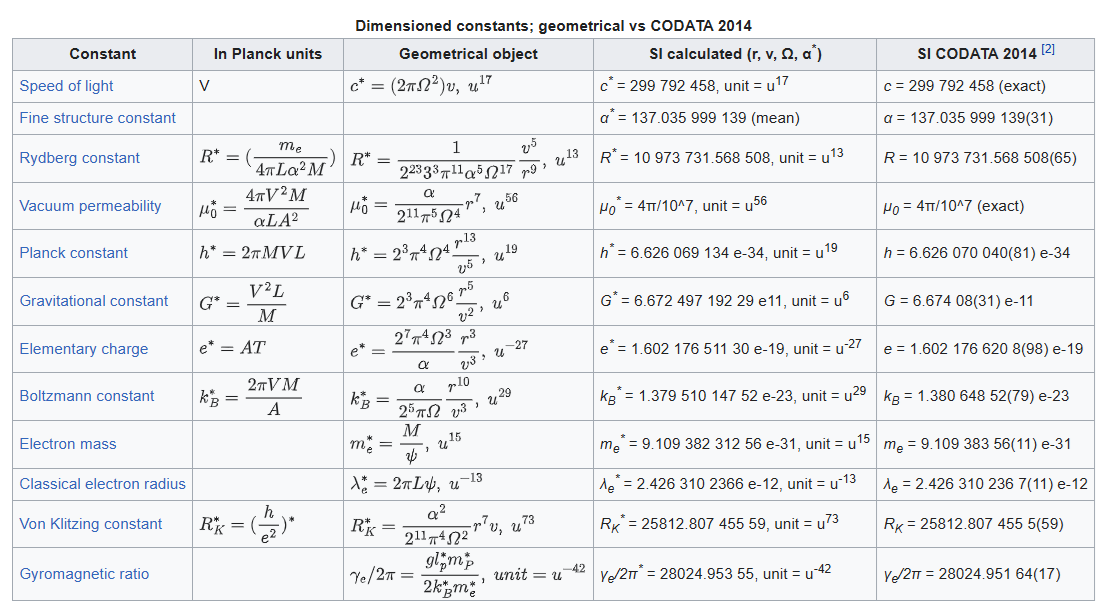
The Programmer God
A general mathematical universe has no defined boundaries and can potentially extend to infinity in all directions (there is no smallest possible unit). A simulation universe however is a specific mathematical universe in that it is fundamentally discrete (pixelated). I argue that this model resembles the simulation universe variation in which the OS is programmed at the Planck scale. Alpha does not appear as an 'internal' derived constant and therefore may be a given (encoded within the source code itself). Pi and e can be derived by an expanding universe in series and so are labelled here as mathematical constants.